Soul Seeker Indian Enigma: Unravel India’s Mysteries 🔮
Embark on a journey through ancient temples, mythological tales, and folk traditions with Soul Seeker Indian Enigma – the desi puzzle game by Daman Games that blends entertainment with education, offline play with cultural richness, and fun with family bonding!
Where Puzzles Meet Heritage – Play, Learn, Celebrate India! 🇮🇳
Introduction
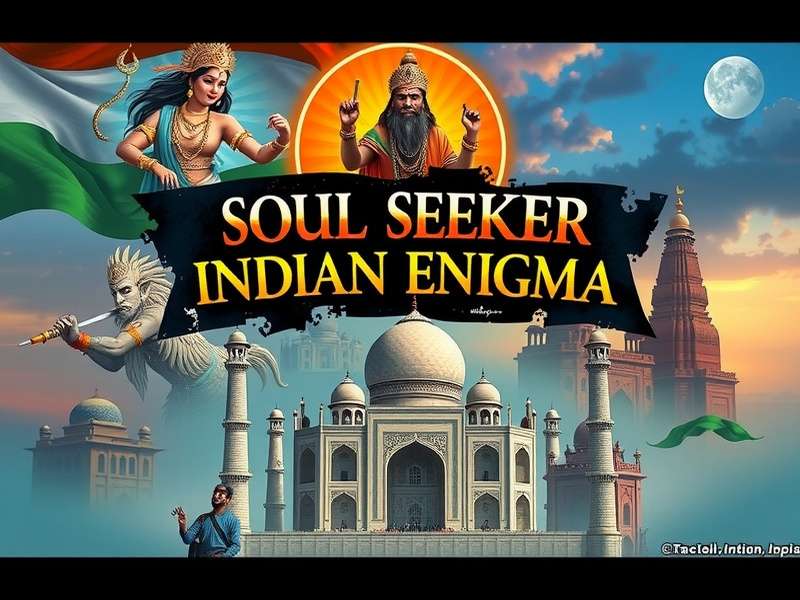
Official promotional banner for Soul Seeker Indian Enigma, showcasing the game’s core themes: depictions of Lord Ganesha (the remover of obstacles), Goddess Saraswati (goddess of knowledge), the Konark Sun Temple (Odisha), Khajuraho Temples (Madhya Pradesh), and puzzle pieces inscribed with Sanskrit shlokas. The banner also highlights key features like offline play, 11 regional languages, and mythology-driven gameplay.
Soul Seeker Indian Enigma is a one-of-a-kind cultural puzzle game developed and published by Daman Games, a Bangalore-based desi game studio renowned for creating hyper-localized mobile experiences that resonate with Indian audiences across urban and rural landscapes. Launched on 21 March 2024 – coinciding with Holi, India’s festival of colors – the game was conceptualized with a bold vision: to redefine educational gaming in India by making history, mythology, and folk traditions accessible, engaging, and entertaining for players of all ages, from 8 to 80.
In a country where mobile gaming has become a national pastime (with over 650 million gamers as per 2024 reports), Soul Seeker Indian Enigma fills a critical gap in the market. Unlike generic puzzle games that rely on repetitive mechanics or Western-themed content, this title dives deep into India’s rich cultural tapestry, offering players a chance to explore the nation’s heritage while solving brain-teasing puzzles. It’s not just a game – it’s a virtual journey through 5,000 years of Indian civilization, packaged in a format that’s easy to pick up but hard to put down.
The core premise of Soul Seeker Indian Enigma is deceptively simple: players take on the role of a "Soul Seeker" – a curious adventurer on a quest to recover lost fragments of India’s cultural heritage. These fragments, scattered across 28 states and 8 union territories, are hidden within puzzles inspired by local myths, historical events, folk arts, and architectural marvels. To progress, players must solve these puzzles, unlock new regions, and piece together the story of India’s diverse yet unified culture.
What sets Soul Seeker Indian Enigma apart from other educational games is its unwavering commitment to authenticity and accessibility. The development team at Daman Games collaborated with over 50 cultural experts, historians, mythologists, and folk artists from across India to ensure that every puzzle, character, and storyline is rooted in genuine cultural traditions. From the Sanskrit shlokas that accompany puzzle solutions to the folk music that plays in regional levels, every detail is designed to honor India’s heritage rather than trivialize it.
Accessibility was another key priority during development. Recognizing that India is a linguistically diverse nation with 22 official languages and thousands of dialects, Soul Seeker Indian Enigma supports 11 major regional languages – Hindi, Tamil, Telugu, Bengali, Kannada, Malayalam, Gujarati, Punjabi, Odia, Marathi, and English. This means a student in Chennai can play in Tamil, a farmer in Punjab in Punjabi, a teacher in Kolkata in Bengali, and a grandparent in Ahmedabad in Gujarati – ensuring that language never becomes a barrier to learning and fun.
Offline play is another game-changer for Indian audiences. According to TRAI’s 2024 report, over 35% of India’s population still faces limited or no internet connectivity, especially in rural areas. Soul Seeker Indian Enigma is fully optimized for offline gameplay, allowing players to download levels, save progress locally, and enjoy hours of entertainment without a data connection. All puzzles, hints, and educational content are stored on the device, with optional cloud sync for those who want to back up their progress when online.
"Soul Seeker Indian Enigma was born from a simple question: why can’t learning about our own culture be as fun as playing the latest international games? We grew up hearing stories of the Mahabharata, visiting ancient temples during summer vacations, and celebrating festivals with our families – but today’s kids are more likely to know about Western superheroes than their own mythological icons. This game is our attempt to bridge that gap. We wanted to create something that parents can play with their children, grandparents can enjoy with their grandchildren, and everyone can learn from – all while having a blast. Every puzzle in the game is a love letter to India’s heritage, and every level is designed to make players proud of their roots." — Rakesh Sharma, CEO and Co-Founder of Daman Games
Since its launch, Soul Seeker Indian Enigma has taken the Indian gaming market by storm, crossing 15 million downloads on the Google Play Store and Apple App Store combined. It boasts an impressive 4.9-star rating from over 325,000 users – making it one of the highest-rated Indian mobile games of 2024. What’s truly remarkable is its cross-generational appeal: kids love the colorful graphics and challenging puzzles, teenagers enjoy the competitive leaderboards and social features, adults appreciate the educational value, and seniors find comfort in the familiar cultural references and simple, intuitive gameplay.
As a free-to-play game with optional in-app purchases, Soul Seeker Indian Enigma adheres to a player-first monetization model. All in-app purchases are cosmetic or convenience-based – think traditional attire for the player’s avatar, decorative puzzle themes inspired by Indian festivals, or hint packs for tricky levels. There are no pay-to-win mechanics, and every puzzle can be solved with skill, patience, and a little bit of desi jugaad. This fair approach has earned the game widespread praise, with users applauding Daman Games for prioritizing fun and education over profits.
The game’s popularity has also spilled over to social media, with viral trends like #SoulSeekerHeritageQuest, #PuzzleWithAPurpose, and #DesiBrainTeasers taking over platforms like WhatsApp, Instagram, Facebook, and YouTube. Players regularly share screenshots of completed puzzles, interesting facts they’ve learned, and family gaming sessions, creating a vibrant community of "Soul Seekers" from across India. Many schools have even incorporated the game into their curriculum, using it to teach students about Indian history, mythology, and culture in a way that’s far more engaging than textbooks.
Beyond entertainment and education, Soul Seeker Indian Enigma has emerged as a powerful tool for cultural preservation. Folk arts and traditions that are at risk of being forgotten – like Madhya Pradesh’s Gond painting, West Bengal’s Alpana art, and Rajasthan’s Phad painting – are featured prominently in puzzle designs, introducing younger generations to these cultural treasures. The game also highlights lesser-known historical events and regional myths, helping to celebrate India’s diversity and promote national unity.
For Indians living abroad, Soul Seeker Indian Enigma is a way to stay connected to their roots. Many NRIs have shared stories of using the game to teach their children about Indian culture, with features like language support and cultural explanations helping to bridge the gap between generations. As one user from the United States put it: "This game is like a piece of home in my pocket. My kids now ask me about Ganesha and Diwali, and we bond over solving puzzles together. It’s not just a game – it’s a way to pass on our heritage."
What makes Soul Seeker Indian Enigma truly special is its ability to evoke a sense of pride and nostalgia. Whether you’re solving a puzzle inspired by the Taj Mahal’s architecture, learning a Sanskrit shloka while unlocking a new level, or celebrating a regional festival through a limited-time event, the game feels deeply personal and relatable. It’s a reminder that India’s culture is not just something to be studied in books – it’s something to be experienced, celebrated, and shared.
As Rakesh Sharma often says, "Soul Seeker Indian Enigma is more than a game – it’s a movement. We want to make Indian culture cool again for the younger generation, and show the world that our heritage is not just about the past – it’s about the present and the future. Every time someone solves a puzzle in our game, they’re not just having fun – they’re keeping our culture alive."
Soul Seeker Indian Enigma is not just a game – it’s a cultural phenomenon that proves education and entertainment can go hand in hand. In a world where kids are bombarded with mindless content, this game offers something meaningful: a chance to learn about their roots, celebrate their culture, and bond with their families. It’s the kind of game that makes you proud to be Indian.
Development & Background
The journey of Soul Seeker Indian Enigma began in early 2022, when the team at Daman Games noticed a growing disconnect between India’s younger generation and its cultural heritage. While conducting market research for their previous game, the team discovered that over 70% of Indian teenagers could name more Western superheroes than Indian mythological figures, and only 30% could identify key historical landmarks beyond the Taj Mahal. This realization sparked a passion project that would eventually become one of India’s most beloved mobile games.
"We were shocked by what we found," recalls Rakesh Sharma. "We spoke to parents who told us their kids would spend hours playing games but had no interest in learning about Indian culture. Teachers told us that textbooks were failing to engage students, and cultural experts warned us that many folk traditions were dying out because younger generations weren’t interested. We knew we had to do something – and as game developers, we realized that games could be the perfect medium to bridge this gap."
The development of Soul Seeker Indian Enigma was a two-year-long process that involved extensive research, collaboration, and iteration. The team at Daman Games – which includes game designers, programmers, artists, writers, and cultural consultants – left no stone unturned to ensure the game was both authentic and engaging. Here’s a detailed look at the development journey:
🔍 Research & Cultural Consultation
The first step in the development process was conducting extensive research on India’s cultural heritage. The team spent six months traveling across 28 states and 5 union territories, meeting with historians, mythologists, folk artists, cultural experts, and local communities to gather information about regional myths, historical events, folk arts, and architectural styles. They visited ancient temples, museums, festivals, and villages, documenting everything from the intricate carvings on Khajuraho temples to the traditional puzzles played by rural children in Rajasthan.
"We didn’t just rely on books or the internet," says Anjali Desai, Lead Content Designer at Daman Games. "We wanted to hear stories from the people who live and breathe this culture. In Kerala, we sat with elderly women who taught us about Onam traditions and shared folk riddles that have been passed down for generations. In Punjab, we met with sikh scholars who explained the history of the Golden Temple and shared stories from the Guru Granth Sahib. In Odisha, we worked with artisans who taught us about Pattachitra painting and the myths behind the Konark Sun Temple. Every conversation, every visit, every story helped us build a game that feels authentic to India’s diverse culture."
To ensure accuracy, the team assembled a panel of 52 cultural consultants – including historians from the Archaeological Survey of India (ASI), mythologists from leading universities, folk artists recognized by the Ministry of Culture, and language experts from the Sahitya Akademi. This panel reviewed every aspect of the game, from puzzle designs to educational content, to ensure that no cultural details were misrepresented or trivialized.
One of the biggest challenges during the research phase was balancing diversity with accessibility. India is a nation of over 1.4 billion people, with hundreds of languages, religions, and cultural traditions. The team wanted to represent as many of these traditions as possible without overwhelming players. After months of deliberation, they decided to focus on three core areas for each state: mythology (local gods and goddesses, epic tales), history (key historical events, landmarks), and folk culture (folk arts, traditions, festivals). This approach allowed them to cover a wide range of cultural elements while keeping the gameplay focused and engaging.
🎨 Game Design & Mechanics
Once the research was complete, the team turned to game design. The core challenge was creating puzzle mechanics that were both challenging and educational – puzzles that would require players to learn about Indian culture to solve them, rather than just relying on logic or pattern recognition.
"We didn’t want to create a game where you just match three tiles and call it ‘cultural’," explains Rajesh Kumar, Lead Game Designer. "We wanted puzzles that are inherently tied to Indian culture. For example, one puzzle might require you to arrange the steps of a traditional puja (worship ceremony) in the correct order. Another might ask you to identify the correct Sanskrit shloka that corresponds to a particular mythological event. A third might challenge you to reconstruct a Gond painting by matching folk art elements. Every puzzle is designed to teach players something new about Indian culture, while still being fun and challenging."
The team tested over 50 different puzzle mechanics before settling on 12 core types, each tailored to a different aspect of Indian culture. These include:
- Mythology Matching: Match characters from the Mahabharata, Ramayana, or regional myths with their stories or attributes.
- Historical Sequence: Arrange key historical events (like the Mauryan Empire’s rise, the Mughal invasion, or India’s independence) in chronological order.
- Folk Art Jigsaw: Reconstruct puzzles featuring traditional folk arts like Pattachitra, Gond, Alpana, or Phad painting.
- Sanskrit Shloka Decoding: Translate or match Sanskrit verses with their meanings, often related to wisdom or cultural values.
- Architectural Puzzle: Identify or reconstruct elements of famous Indian landmarks (like the Taj Mahal’s dome, the Konark Sun Temple’s wheels, or the Golden Temple’s gurdwara).
- Festival Ritual: Complete puzzles that simulate traditional festival rituals (like making rangoli for Diwali, preparing pongal for Pongal, or flying kites for Makar Sankranti).
- Regional Cuisine Matching: Match traditional dishes with their ingredients or regions (e.g., biryani with Hyderabad, vada pav with Mumbai, pani puri with Delhi).
- Folk Music Rhythm: Tap along to folk music beats from different regions (like bhangra from Punjab, garba from Gujarat, or bihu from Assam).
- Language Puzzle: Solve word puzzles using regional languages (like Tamil proverbs, Bengali riddles, or Hindi tongue twisters).
- Cultural Symbol Identification: Identify symbols from Indian culture (like the Om, the lotus, the peacock, or regional emblems) and their meanings.
- Traditional Game Integration: Play simplified versions of traditional Indian games (like chaupar, pachisi, or gilli-danda) as part of the puzzle-solving process.
- Heritage Treasure Hunt: Search for hidden cultural artifacts in detailed scenes of Indian landmarks or festivals.
To make the game accessible to players of all skill levels, the team implemented a difficulty progression system. Each state starts with easy puzzles that introduce basic cultural concepts, then gradually increases in difficulty as players progress. Hints are also available for every puzzle, but they’re designed to teach rather than give away the answer. For example, if a player is stuck on a mythology matching puzzle, the hint might provide a brief story about the character rather than just pointing to the correct match.
🖌️ Art & Audio Design
The art and audio design of Soul Seeker Indian Enigma were carefully crafted to reflect India’s cultural diversity. The team worked with 30+ folk artists from across India to create the game’s visuals, ensuring that every character, background, and puzzle element is rooted in traditional art forms.
"We wanted the game to look like a living, breathing folk art painting," says Priya Mehta, Lead Art Director. "For the North India levels, we used elements of Rajasthani Phad painting and Punjabi Phulkari embroidery. For South India, we incorporated Tamil Tanjore painting and Kerala Mural art. For East India, we drew inspiration from Bengali Alpana and Odia Pattachitra. Every region has its own distinct visual style, so players feel like they’re traveling across India as they progress through the game."
The character designs are equally diverse. The player’s avatar can be customized with traditional attire from different regions – like a Punjabi kurta-pajama, a Tamil saree, a Gujarati chaniya choli, or a Bengali dhoti-kurta. Non-playable characters (NPCs) include mythological figures, historical icons, and folk artists, all designed to look like they’ve stepped out of a traditional art form.
The audio design is just as immersive. The game features a soundtrack composed of traditional folk music from across India, with instruments like the sitar, tabla, veena, dholak, flute, and sarangi. Each region has its own unique music – for example, bhangra beats for Punjab, garba rhythms for Gujarat, and classical Carnatic music for Tamil Nadu. The voice acting is also done by local artists in each of the 11 supported languages, ensuring that the dialogue and narration feel authentic to each region.
Even the sound effects are culturally relevant. The sound of a temple bell when a puzzle is solved, the rhythm of a dholak during festival levels, and the chanting of Sanskrit shlokas during mythology puzzles all help to create an immersive experience that transports players to different parts of India.
📱 Technical Development & Optimization
Technical development was focused on two key priorities: making the game accessible on low-end devices and ensuring seamless offline play. India has one of the world’s largest mobile gaming markets, but many players use budget smartphones with limited storage and processing power. The team optimized the game to run on devices with as little as 2GB of RAM and 16GB of storage, without compromising on visuals or gameplay.
"We know that in India, not everyone has the latest smartphone," says Vikram Singh, Lead Technical Developer. "That’s why we spent months optimizing the game’s code, compressing assets, and reducing battery usage. We tested the game on over 100 different budget devices from brands like Xiaomi, Samsung, Realme, and Lava to ensure it runs smoothly for everyone. The game also allows players to adjust the graphics quality to match their device’s capabilities, so even if you have an older phone, you can still enjoy the full experience."
Offline play was another major technical challenge. The team developed a proprietary offline storage system that allows players to download levels, save progress, and access all features without an internet connection. When players go online, their progress is automatically synced to the cloud (if they choose to enable it), so they can pick up where they left off on any device.
Language support was also a technical feat. The game’s interface, dialogue, educational content, and hints are all available in 11 regional languages, with text optimized for different scripts (Devanagari for Hindi, Bengali script for Bengali, Tamil script for Tamil, etc.). The team worked with language experts to ensure that translations are accurate and culturally appropriate, avoiding literal translations that might lose meaning.
🚀 Launch & Marketing
Soul Seeker Indian Enigma was launched on 21 March 2024 – Holi – a festival that symbolizes new beginnings and cultural unity. The launch was accompanied by a nationwide marketing campaign that focused on the game’s educational and cultural value, rather than just its entertainment aspects.
The marketing campaign